Laundry could be as little as a few square meters and will be the single biggest water user in the house. Leaking hoses, overflowing machines, boots getting wet, towels getting damp and the odd bucket of mop water... if you get the wrong laundry tiles you’ll quickly find out. The floor will be all slippery, or the grout will stay grey and damp or the water will have worked its way back into the wall behind the tubs.
A humid summer becomes a cold damp winter in Melbourne which makes the job of the workers. This post looks at what is appropriate for a small wet area, what they ask the customers to do prior to them starting and the common renovation mistakes.
Quick answer
- Floor: all round, porcelain tiles with a proper slip.
- Splashback: a grout line which you can keep clean (glazed ceramic or porcelain).
- Waterproofing is underneath the tile, it doesn’t mean the tile is waterproof.
- Grout: make it narrow and use a good quality grout or sealer as grout is the weak link in any wet room.
- Tile size: small rooms are best with medium sized tiles. The more small mosaic tiles you have the more grout you’ll have to keep up with.
Why Laundry Tiles should be given some effort
A shower is in the bathroom and there's floor waste in the bathroom. A laundry won’t have any of that; there’ll be water all over the place. The machine hoses will burst, the washing tub will overflow and the wet washing will be carried right across the floor. The room is also fairly small and very poorly ventilated so there’s always a build up of moisture.
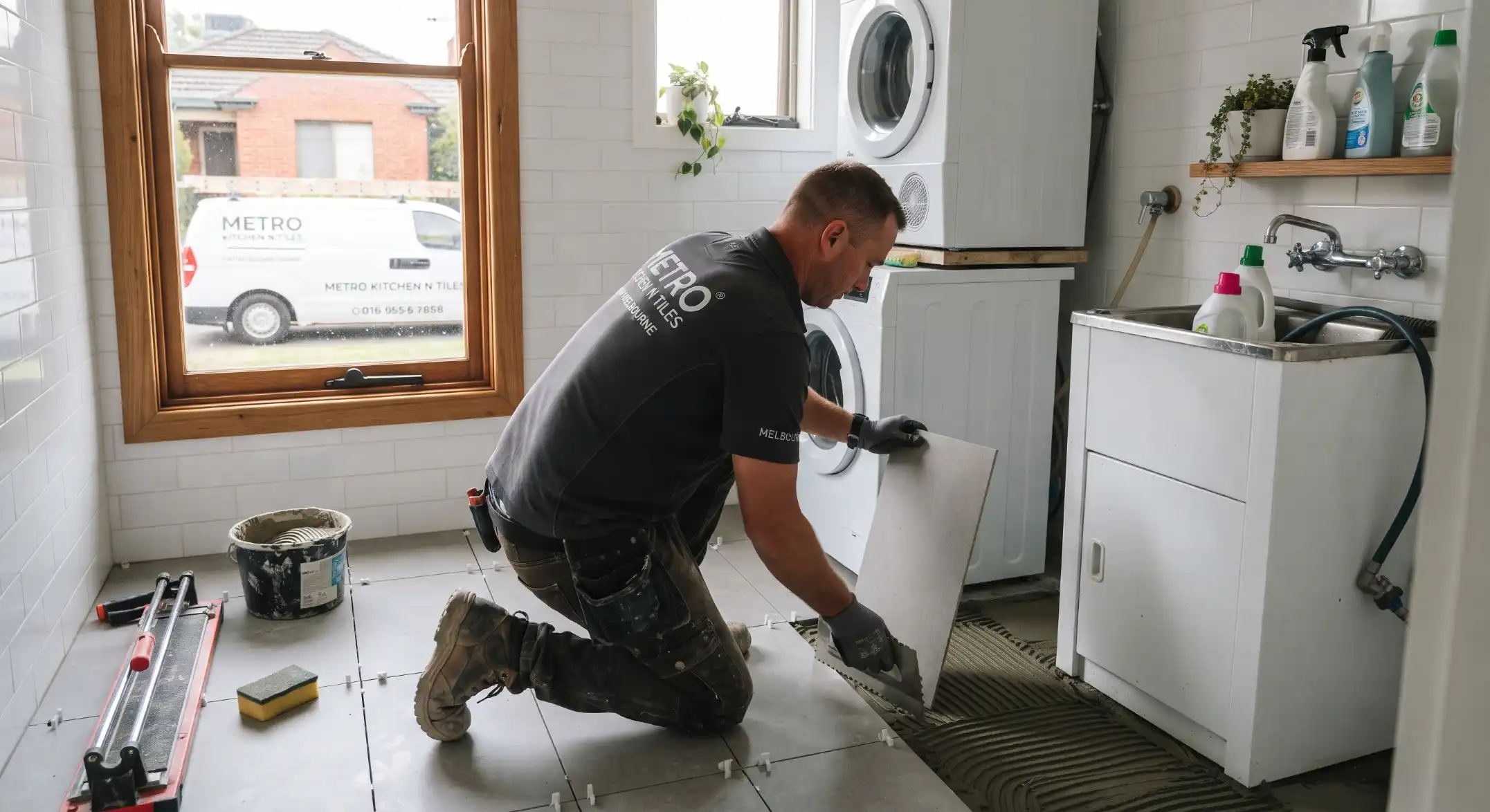
This is why the choice of tile is so important really (more so than you’d think). It has to be able to cope with being wet, it has to have good grip when it’s wet and it has to be both detergent and dye resistant.
The choice of laundry floor tiling is a difficult one
Porcelain vs ceramic vs natural stone
Porcelain would be the way to go for the toilet floor tiles. It’s heavy, it’s very low water, and it will take the beating.
- Porcelain: ignores water, very durable and available in a wide range of finishes. Our normal recommendation.
- Ceramic is great for walls (it’s a softer, more porous material and therefore not as popular for floor coverings which are going to be walked on every day and are going to be in a moist environment).
- Natural stone: needs sealing and will stain with laundry detergents. It’s going to be a very fussy option in a room like this.
What ‘non-slip tiles’ actually means is slip resistance.
The term ‘non-slip tiles' is just another way of saying slip resistance.
‘Non-slip’ is just a marketing term really, not a guarantee! Slip resistance of the tiles is tested and graded in Australia and a rougher surface will be harder to clean but will have a greater frictional component.
A medium texture porcelain, something with a matt finish would be a sensible choice for a home laundry. The wet floor, dry foot, highly polished tiles have been in the show house and they’re absolutely fine to walk on, just be aware they do look quite glossy. Check with your supplier as to the slip rating of the tile and be careful of any that are shiny.
Tile size and grout
If you’ve got a rather tight laundry you’ll probably find getting around the tub, the washing machine and the door with large format tiles is a bit of a pain as there’s just too much of it. Medium format tiles are the way to go. Small mosaics will give you excellent foot grip, just all the grout lines are going to end up with lint and moisture in them.
It’s the grout that fails first really. A wider joint will of course hold more water and poor quality grout will take up the water. Use good quality grout, use a grout sealer and go for a mid tone grout color. Very bright white will show all the stains and very dark grout will show the soap.
Laundry Splashback: How Water Can Cause Damage
A splashback is fitted behind the sink or tub to protect the wall from the splashes, the steam and the rarer overflows. Plasterboard takes in moisture so it’s a job that takes a long time to get right. Some of the things we look at:
- CROW: Tilt CROW: Tilt it up to the tap line or above if the tub is in a corner or waters the tub.
- Corners: Use flexible sealant (not grout) at the tile edges where they meet the tub edge, the benchtop or the internal corners.
- Surface: They wipe clean very easily with glazed tiles. Splashbacks that are very textured are going to hold the dirt.
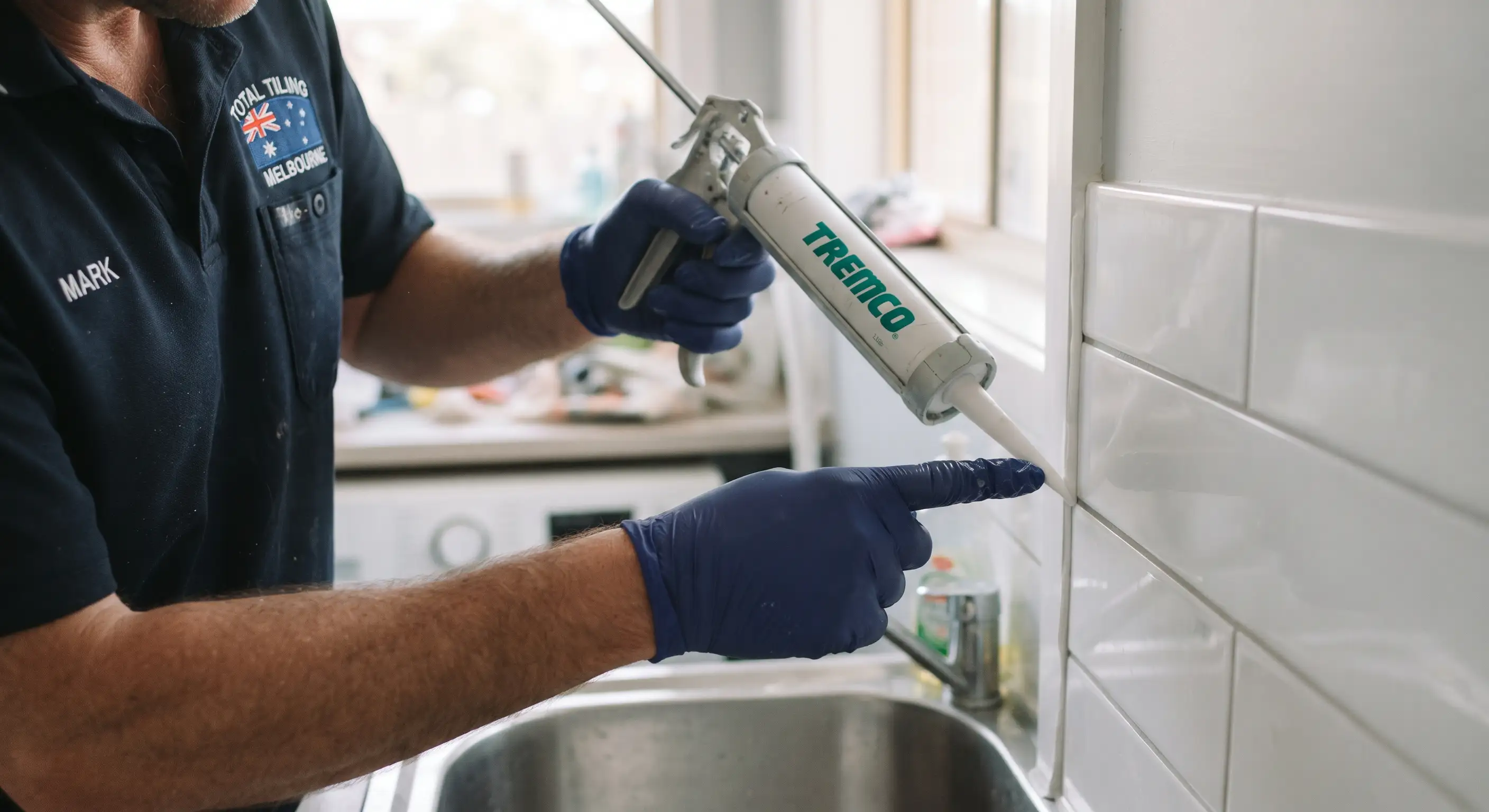
Laundry is attached to the kitchen space; the design of the tiling might match cabinetry grout colors. We’ve written a post about how to match tile colors with cabinet finishes.
Waterproof Tiles ≠ Waterproofing
This is the big one. “Waterproof tiles” are tiles that are water-resistant (i.e., porcelain). Water will still get through the grout lines and down to whatever is below. The membrane that’s placed underneath the tile is the waterproofing, and that’s what protects the floor and the walls.
The laundry requirements will vary depending on the layout (e.g., above the living area or floor waste). You should ask your licensed professional which is the case for your property. When you’re fitting a wet area, if your tiler doesn’t mention waterproofing, ask why.
Laundry Tiles at Melbourne Homes: What is different?
The difference with Laundry Tiles at Melbourne Homes is clear:
Older homes
(many of the Victorian and Edwardian cottages) will have had laundries at the back of the building, sometimes with timber floors at an uneven level. Those floors will generally have to be tilted prior to the new tile being laid, and there may be some type of underlayment applied to prevent cracking.
Reactive clay.
The majority of the area is underlain by reactive clay soil, which expands when wet and contracts when dry. It’s not just the tiles, really; you need to prepare the slab and lay it with movement joints, or the tiles are going to crack as a result of the slab movement.
Humidity and ventilation.
The days in Melbourne in winter are cold and damp, and laundries generally don’t have any windows or, indeed, a very large window. A good sweep of air or a fan will go a long way to keeping the moisture down, and the grout will last a lot longer.
Tight layouts.
A lot of the laundries are small with just a door leading into them. Always allow for cutting tiles and for any clearance required for doors when you’re placing your order, and allow for clearance at floor level to the adjacent room.
Laundry Tile Options Compared
Here are the pros and cons of the laundry tile options you have.
| Tile type | Details |
|---|---|
| Images / Photos / Photos & special occasions | Ideal. Consider that the image is not intended for daily wear and tear. |
| Matt porcelain floors | Durable, low absorption, provides good grip. Textured finishes are harder to clean. |
| Glazed ceramic splashbacks and walls | Many styles, easy to wipe, softer, not really suitable for floors. |
| Mosaic tiles | Low-level floors around floor wastes. Very good grip, follows falls. Significant grout work to maintain. |
| Natural stone | Feature areas which tend to need sealing, are prone to staining and have a very distinct look. |
| Non-slip against mold and mildew | Low traffic (dry) only. Modern handle. Slippery when wet. |
Common Mistakes to Avoid
Here are a few tips on what not to do when writing in pictures;
- Choose on the basis of looks only. A photo-friendly tile installed on a damp laundry floor can be a hazard.
- Skip the waterproofing. A beautiful floor on a poor base is going to be a very expensive repair later on.
- Ignore the subfloor completely. A soft, rough, or wet subfloor will move, and the tiles will crack.
- Application of sealant in the wrong place. There should be flexible joints at the corners and at the changes of plane.
- Forget ventilation. So don’t go for the tiles; think about the damp room. Its destructive potential is going to work its way through the grout and the mold.
- Failure in the planning of falls. A floor has to slope if there’s any floor waste. Otherwise, water pools.
How much is it to have laundry tiles around the house?
The cost of the project will be dependent on the tile you select, the condition and access to the room, and will vary considerably. In terms of supply cost and labor cost of tiling in Melbourne, the mid-range porcelain will be somewhere between $30 and $90 per square meter, and the labor cost in Melbourne will be somewhere between $50 and $100 per square meter. There is no charge for preparation and waterproofing.
A typical total for a typical small laundry is in the low thousands of dollars. This will be further increased by removing old tile, repairing any damaged subfloor or relocating plumbing. Understandably, it’s not a good idea to compare tradies without a written quote that itemizes the preparation, waterproofing, and materials.