You wipe the benchtop down after dinner, and by morning, you can see the imprint of the lemon wedge. Or a black spot from the olive oil that was poured in. Natural stone isn’t as indestructible as it sounds when people become too tough and start to use the wrong cleaning chemicals. Natural stone does not have indestructible qualities, as it is destroyed most of the time by too much toughness and the use of the wrong cleaning chemicals in Melbourne kitchens.
Fortunately, all it takes is about 2 minutes a day of education and a bit of seasonal care to learn how to clean stone benchtops. Listed below are those to use, those to avoid, the methods for lifting stains, and rules for resealing when it’s time. It is for all natural stone surfaces, such as granite, marble, quartzite, and others, both at your own home and your rental home or vacation property.
Short answer: Use warm water and a stone cleaner (pH neutral) with a soft microfibre cloth to wipe daily and dry the surface. Mop up spills immediately, then flush with plenty of water and avoid using vinegar, lemon, bleach, or gritty replenishers, and replace any porous stone in use with replacement stone every 1–3 years, depending on the type of stone.
How to Clean Stone Benchtops Every Day
For a maintenance man, most of the work for stone benchtop maintenance involves a simple go-to routine.
- Clear and brush. Take things out and clean away any crumbs and dirt with a soft, dry cloth. Scratching occurs when grit is dragged around the indus. soft stone.
- Mix your cleaner. Add a few drops of pH-neutral stone cleaner (or mild dishwashing liquid) to warm water in a spray bottle.
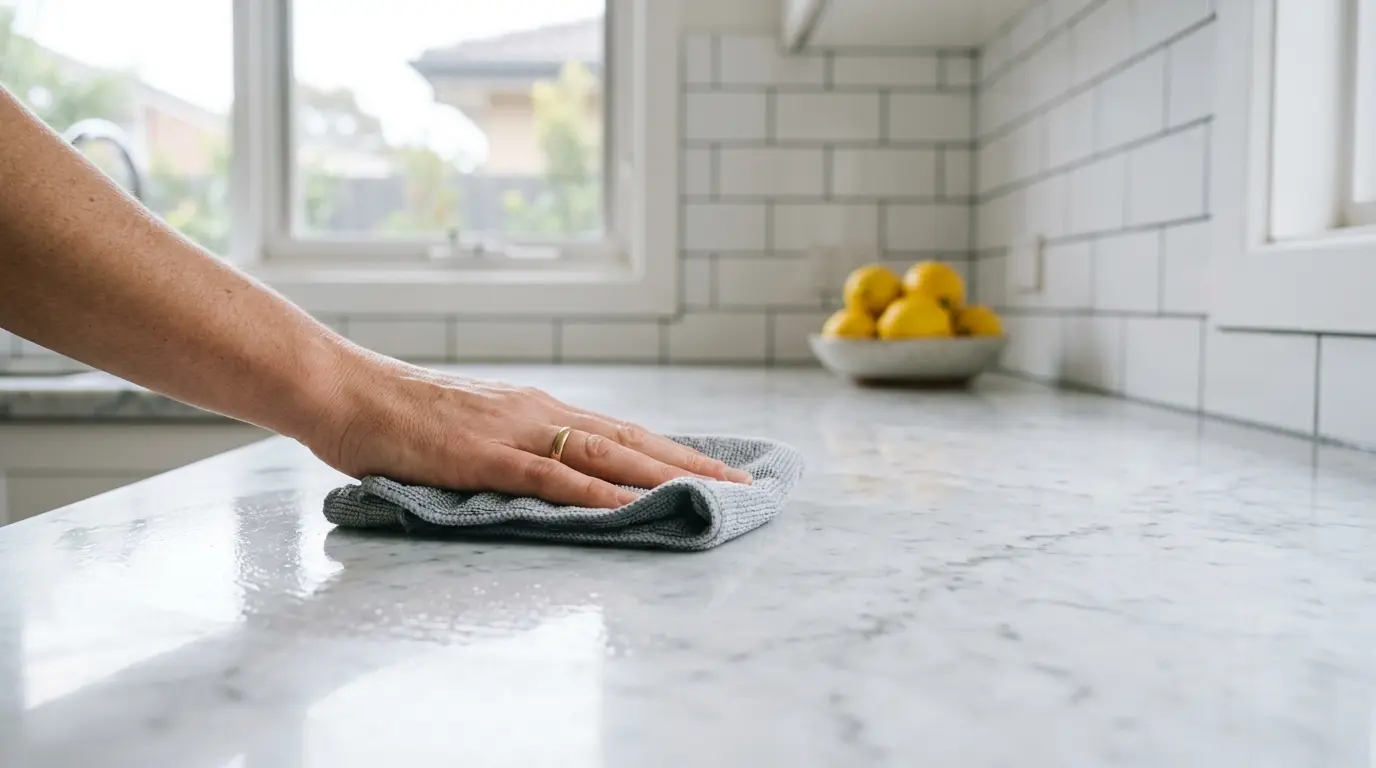
- Spray and wipe. Damp a microfibre cloth and wipe along the stone’s length.
- Rinse. Repeat the process, wiping with plain water until the soap film is gone.
- Dry. Cover with a clean, soft towel. It prevents water spots and streaks, particularly with dark-colored stone.
Clean the kitchen top weekly.
Spot-check the areas where residue accumulates on a weekly basis: around the taps & sink, around the splashback join, and close to the cooktop. But wash down the clothes as well! Use a dirty rag only.
To avoid wasting time and effort, determine your stone’s texture before you pick it up for cleaning.
Natural stone cleaning isn’t one-size-fits-all. The effect of the same spill will vary on different marble, granite, and quartzite.
| Stone | How it behaves | Biggest risk | Care note |
|---|---|---|---|
| Granite | Dense and hard, but slightly porous | Can stain with oil or wine (if not sealed) | Use a pH-neutral cleaner and seal on a regular basis. |
| Marble | These are soft and have calcium, and are sometimes polished. | The results of corroding with an acid, scratching, | Seal spills and clean up right away |
| Quartzite | Hard, will not etch, very hard | In certain types, staining is a well-known occurrence. | Seal (as per supplier’s recommendation) |
| Limestone/travertine | Lacks pleasant and extremely absorptive | Acids, stains, scratches | Make sure to seal, and be extra careful |
Request the name of the actual stone type from your supplier; ask for a care sheet. Don’t assume that some stones sold as quartzite act like marble.
How to Seal and Conduct the Water Test on Stone Benchtops.
The majority of natural stones are porous. These pores are filled by the sealer to prevent spilled liquid from being absorbed by the floor beneath the surface and to allow the stain to remain for a while after making the spill so that you can mop it up. It doesn’t render stone stain-proof and will not prevent acid from staining marble.
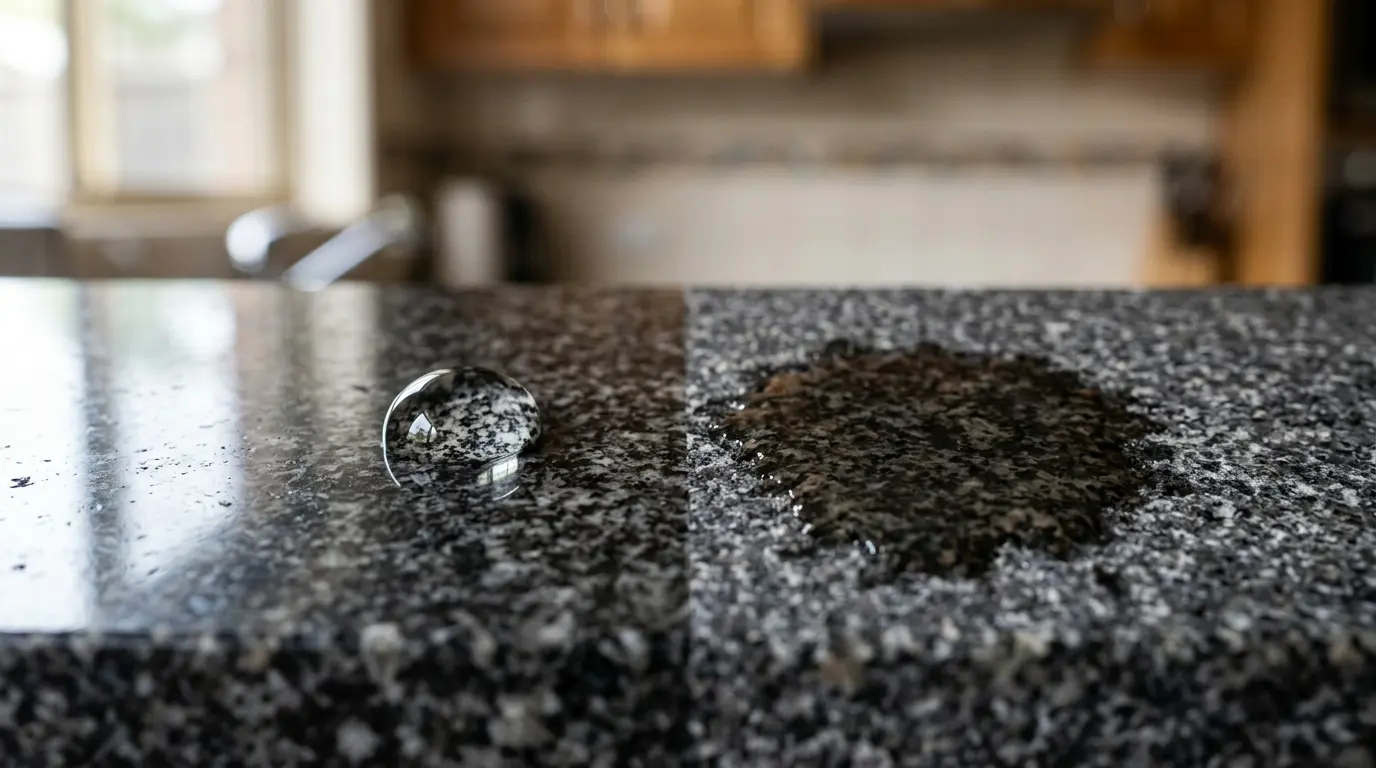
The water sample can be tested for 15 minutes.
Place a few drops of water on the stone in two or three spots, such as near the sink, near the cooktop, and in the middle. Wait 10 to 15 minutes. The sealer is working if the water beads. If the stone becomes black, then it is absorbing moisture; resealing is required.
How often to reseal
A general rule of thumb is that marble or limestone should not be sealed more often than every 6-12 months, and granite should not be sealed more often than once every 1-3 years. Quartzite varies. The label placed on the sealer always prevails.
How to reseal
- Thoroughly clean the stone and dry it thoroughly, preferably overnight.
- Use an impregnating natural stone sealer with a lint-free cloth in sections.
- Set aside according to the label, usually 5 to 15 minutes, then wipe the excess off, or it will rub off and become a sticky film.
- Leave it to cure, usually for 24 hours, prior to heavy use or wet spills.
An insurance that will be around 30-90 will usually be a consumer model sealer, so it’s insurance for a benchtop that can cost thousands of dollars.
Here are some helpful tips if you need to clean up stains on the stone benchtops.
Match the process to the stain. Always check a SECRET SENSEIT place first.
| Stain | Common cause | What to try |
|---|---|---|
| Oil-based | The products include cooking oil, butter, and grease. | Baking soda poultice (below) |
| Organic | Coffee and tea, wine, fruit | Stone-safe poultice (or just a little amount of 3% hydrogen peroxide on light-colored stone) |
| Dark water patches | Rotting glass, soaking rags, gopher doors | Typically it becomes dry in a day or two. If they remain, re-seal |
| Dull areas (etch marks) | Marble with lemon, vinegar, tomato, or wine on it | Marshmallow, trek powder or specialist polishing powder. The problem is with the surface; wiping won’t help. |
| Rust | Cans, pots and utensils of metal | Seek advice from a specialist for a rust poultice or call a professional |
How to make a DIY poultice
- Pour in baking soda and add water as needed: it should be like peanut butter consistency.
- Thin drippings around the stain by spreading it about 5 mm thick, slightly overhanging the edges.
- Line from now with plastic wrap and then tape around the edges. Leave for 24 hours.
- Take out, clean with a wrung-out washcloth and pat it dry. If the stain is an old one, 2 or 3 treatments may be required.
Most of the common mistakes when having stone benchtops installed need to be avoided.
- Washing with vinegar, lemon, or bathroom cleaners with acid. They can carve marble and may abrade the protective coating on other stones.
- Attempting to reach for ammonia or bleach. Either can remove the sealers and stain some stone.
- Use of gritty, cream cleaners or scourers. Causes fine scratching, particularly on shiny surfaces.
- Directing hot pans to the stone. Stone near the cooktop may mark and/or break upon sudden exposure to heat. Use trivets.
- Using a chopping block as a countertop. It makes knives dull, and soft stones will be scratched.
- Avoid spills that will be left to sit. Wine, oil, and coffee are just easier to remove within the first few minutes.
- Sitting or standing on overhangs. With long overhangs, you might have to worry about them breaking when you add weight to them.
Melbourne Conditions That Affect Stone Benchtops
Stone does not mind the weather, but a few local factors ought to be known.
- Open plan extensions and large windows. Glazing is a popular feature in plenty of Melbourne renovations of Victorian and Edwardian properties. Stone is flexible enough that it will withstand the sun; just test the water in the sunny areas first and then cover them.
- Bayside sand and salt. Sand is carried into kitchens in the suburbs near the bay. Use a wet, not a dry, cloth to clean - not to scratch - off the grit.
- Not limescale, but soap film. The walls are less likely to be ‘chalk’ glazed when compared with areas with harder water, which is the case in Melbourne. Clean always with a detergent and rinse after use, as detergent residue will still accumulate.
- Apartments or condos rented or used as investments. If you’re a Melbourne landlord or property manager, take pictures of the condition of the benchtops in the entry report and include the use of pH-neutral cleaners in your cleaning checklist. Soap-swipe cleaners used for all-purpose and bathroom cleaning are a common cause of etched marble at the time of the bond.
- Outdoor kitchens. Graffiti stones deteriorate when used near BBQs and from the weather elements. When using stone for outdoor areas, use outdoor stone and seal with an outdoor sealant.
Call a professional if you notice one or more of the following:
It’s time to get help if you notice:
- Areas that are deeply lysed or areas that are abraded and have dull surfaces throughout a large area
- Repeated rustling of stains.
- Chips or cracks can be found along edges, sink cut-outs, or joins.
- Water permeated through the seal even after the seals were retrofitted.
- The grout lines around the splashback are stained and/or breaking away.
A stone specialist can polish, sharpen, chip, and reseal appropriately. Professional polishing or light restoration usually runs hundreds of dollars and may be higher for extra deep polishing or repairs, depending on size and condition of the stone.
Engaged Stone or engineered stone: If you have an older benchtop, which comes in a quartz finish, it won’t need any sealing but does require gentle cleaning and heat avoidance. Since 1st July 2024, engineered stone is no longer allowed to be installed in Australia, so natural stone and porcelain are the common materials for new benchtops.